We're back to training. Finally.
But, first, a miracle supplement.
No, really.
Ella and the other shelties eat grass like, well, sheep. And, they never throw it up. I mean, Bear will be running along playing, put his head down and grab a mouthful as he is running. Really. And, they never had stinky-bile-sulfur breath, either.
Until the snow and cold killed off all the green grass. Yep, Ella actually has a scab on her nose from rooting around in the crusty snow trying to find some green stuff. To no avail, poor thing.
I tried adding green veggies to their meals: broccoli, spinach, kale, swiss chard (which they love). They liked the veggies, but got a lot more gas (which make sense, since these are rather gassy-causing veggies).
So, I was cleaning out the dog shelf and found that I has purchased The Honest Kitchen's Perfect Form supplement. Two jars, actually. That's a lot of Perfect Form.
It contains fennel, papain, papaya, pumpkin seed, plantain, pectin and slippery elm. And, is developed to "support the normal healthy functioning of your pet's digestive tract." Well, slippery elm has been used for ages as a digestive supplement - settlers crossing the US used to make a tea out of its bark and some of them ate it to survive the winter! The rest of the stuff in there is also used as stomach and digestive support.
When I first tried it, I tried it when Bear was having a great bout of diarrhea, which wasn't my smartest move ever. Note to self: Do not introduce new supplement if dog is ill - duh. So I put it away on the shelf.
I started the dogs on this Sunday night (note: no one was ill when I started this time). Each dog is receiving 1/8 tsp per meal this week. Next week, I will up this to 1/4 tsp.
The results in just three additions? No bad breath, no more gas, Ella's nose is healing up (but, due to her not rooting for grass, rather than the supplement itself). Robbie slept the sleep of the just and didn't toss and turn.
And, even Possum, with her sensitive (and I mean sensitive - if there are any dyes in the food she eats, you will know exactly what colors were in there when she poops!) stomach can tolerate it.
Great stuff. GREAT stuff and you can get it at Planet Dog in Portland.
Showing posts with label shelties. Show all posts
Showing posts with label shelties. Show all posts
Tuesday, December 30, 2008


Monday, August 18, 2008
Remmie and Chummy
Ella and I drove up to Presque Isle on Saturday to pull Remmie and Chummy from the Central Aroostook Humane Society. They had been brought to the shelter because their human went into the hospital and could no longer care for them.
These pictures are pretty bad!

Remmie, the lighter one above, is at Holly's house. He is 11 and a tired old man.
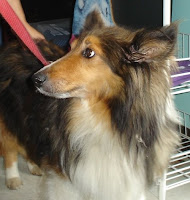
Chummy is with my crew. He follows the others around happily and wags his tail whenever anyone looks him in the eye - cat, dog or person. He is 9 and has a double hip replacement.
Both guys really need some work - coat wise and weight wise!
PS. It is a 7 hour round trip from my house to Presque Isle.
Friday, March 28, 2008
Fencing
I live in a rural town on a dirt road and have 6 acres of land. For the past two years, I have installed, by hand, a metal mesh fence for the dogs. And, for the past two years, the snow has drifted in such a way that the dogs are eventually able to push against the fence and scale the darn thing like a ladder.
Well, I am tired of worrying about where the dogs can go and what they might get into if I don't watch them like a hawk every second that they are outside. I don't want them to go to my bad neighbor's house. I don't want them to go to my nice neighbor's house. I don't want them to follow turkey tracks. Or wander into the road, even though I am set back two acres. I don't want to have to worry about all of this.
So, I am going to have to get a real fence. But, what kind should I get? How should I decide what type?
Features I want in a fence:
Well, I am tired of worrying about where the dogs can go and what they might get into if I don't watch them like a hawk every second that they are outside. I don't want them to go to my bad neighbor's house. I don't want them to go to my nice neighbor's house. I don't want them to follow turkey tracks. Or wander into the road, even though I am set back two acres. I don't want to have to worry about all of this.
So, I am going to have to get a real fence. But, what kind should I get? How should I decide what type?
Features I want in a fence:
- Security Type A (Keep dogs in) - I want the fence tall enough and strong enough so that the dogs can not jump or climb it.
- Security Type B (Keep others out) - I want the fence to keep out as much wildlife as possible. I want it to keep out the bad neighbor's annoying dog. I want it to keep out the bad neighbor.
- Appearance - I want the fence to allow me to see my backyard and enjoy the wildlife that might be outside of the fence. In other words, I want to be able to see through it. I want people driving by to be able to see how much I care about my dogs - by installing a fence.
I have decided on a chain link fence. With gates that allow me to get my lawn mower in, but that can be padlocked to prevent any unwanted persons from getting in. While not the most expensive option, it isn't the cheapest, either. And, I will not be able to afford to fence in my entire property. But, when weighing these minor disadvantages with the advantages of having a real fence, I am more than willing to pay the price of the fence!
I could get an electronic fence. You know, the one with the collar that shocks the dog for getting too close to the invisible fencing. But, this won't keep wildlife away from my dogs. It won't keep that little dog next door away from my dogs. It won't keep people away from my dogs. And, if my dogs really start chasing something, it won't keep them on my property, either.
And, an invisble fence collar delivers physical punishment in the form of a shock. That means it causes pain to prevent a dog from doing something. I don't like physical punishment. Especially when I can solve the problem without resorting to causing pain to my dogs. Because a real fence in a much more visual and kind alternative. I can see if there is a problem with a real fence. I don't have to remember to change batteries or have collars on or worry about lightning or other storms damaging or disrupting the fence.
Pat Miller has written an excellent article about the disadvantages of an invisible fence. Ms. Miller is a well respected positive reinforcement dog trainer with years of experience. There is another great one here. I, myself, have seen some of the problems caused by these fences.
I spend a lot of money on food, vet care, grooming, training, collars, and toys for my dogs. Why would I choose a product that could easily fail? I love my dogs enough to get them the real thing.
Tuesday, March 4, 2008
Toenails
Grace let me clip three (!) of her nails last night! Of course, she was a bit hesitant and pulled back a little on the third nail, but she did great. And, got lots of treats. We'll do a few more tonight.
She is also getting much better about going out the door. She will now come out of her crate when coaxed and, even though she "slinks" across the room, she will allow me to grab her collar when I need to and is walking much better on a leash. She doesn't bolt away in fear anymore, either. In fact, she is doing so well that I am no longer using a drag line inside the house.
Her crate is her safe spot, though, and she doesn't like to come out of it. But, she has gotten to the point where she will stand in the doorway to her little "cave" and watch me while I prepare a meal or give the other dogs their treats. Of course, she gets treats, too, but she isn't ready to brave the room to get one. So, I walk her treat over to her and she will take it out of my hand, rather than cowering in the back of the crate.
And, because she spends so much time in there, even with the door open, I make sure that she gets plenty of stuffed Kongs and playtime outside. The Kongs keep her mind busy and the playtime outside lets her really stretch her legs. She especially likes to roll in the powdery snow. And, she has begun interacting with Robbie and Ella. She greeted Maggie really well last night, too.
And, since the kitchen is the place where we practice our obedience training, she gets to watch the other dogs go through their cues. Last night, she watched Maggie practicing "down." Every once in awhile, I would toss a treat to Grace, just for paying attention while Maggie was in class.
This doesn't seem like much improvement, but it is. She is getting braver and more confident. Tiny baby steps on the road towards adoption.
She is also getting much better about going out the door. She will now come out of her crate when coaxed and, even though she "slinks" across the room, she will allow me to grab her collar when I need to and is walking much better on a leash. She doesn't bolt away in fear anymore, either. In fact, she is doing so well that I am no longer using a drag line inside the house.
Her crate is her safe spot, though, and she doesn't like to come out of it. But, she has gotten to the point where she will stand in the doorway to her little "cave" and watch me while I prepare a meal or give the other dogs their treats. Of course, she gets treats, too, but she isn't ready to brave the room to get one. So, I walk her treat over to her and she will take it out of my hand, rather than cowering in the back of the crate.
And, because she spends so much time in there, even with the door open, I make sure that she gets plenty of stuffed Kongs and playtime outside. The Kongs keep her mind busy and the playtime outside lets her really stretch her legs. She especially likes to roll in the powdery snow. And, she has begun interacting with Robbie and Ella. She greeted Maggie really well last night, too.
And, since the kitchen is the place where we practice our obedience training, she gets to watch the other dogs go through their cues. Last night, she watched Maggie practicing "down." Every once in awhile, I would toss a treat to Grace, just for paying attention while Maggie was in class.
This doesn't seem like much improvement, but it is. She is getting braver and more confident. Tiny baby steps on the road towards adoption.
Monday, March 3, 2008
Classes
I spend so much time with the foster dogs that my own dogs aren't getting the training they need. They get plenty of attention, but their obedience skills are lacking. Here are the things I want to fix in my own dogs:
Ella steals food as often as she can. She will steal candy from babies! Right out of their mouths. She isn't growling or anything, just stealing. I would like Ella to learn a really good "Leave It" this year.
Maggie has awful recall (come). She takes off any chance she gets. She comes back, but in her own, sweet time. This can be nerve wracking when she does this in the fall, during hunting season. I would like Maggie to have a more reliable recall.
Robbie is afraid of strangers, especially men, and children. I would like Robbie to learn to approach strangers without alarm barking.
Bear is also afraid of strangers. It is much harder to get Bear used to strangers, since he is deaf. However, my goal this year for Bear is to take him more places where we can safely get him used to new people.
Spirit has improved so much since she came to me. But, she really needs more basic training, including sit! So, I would like to teach Spirit how to allow collar grabs from me and how to sit to take treats.
I could probably teach all of this at home. In fact, I know I could teach this. But, setting aside the time to spend with each dog individually is really difficult! I have decided that the best way for me to meet these goals is the sign each of my dogs up for a class:
I have signed Ella up for a level 2 class - we will be working on a longer down, stay, recall and better heeling. And, while we wait for class to start, we will be working on leave it. Ella's class starts April 29.
I have signed Maggie up for a basic obedience class. She already knows many of the cues, but the classroom setting will help get her ready for the level 2 classes, which work on recall much more. Maggie's class starts May 31.
I have planned out when I need to sign Robbie up for his Level 1 class and when to sign Maggie up for the Level 2. If Ella does well during the Level 2 class, then I will sign her up for the Canine Good Citizen (CGC) class.
Bear will get to take a class late this fall. In the meantime, I will begin setting up meetings with friends to get Bear used to strangers. I will be doing the same with Spirit.
Ella steals food as often as she can. She will steal candy from babies! Right out of their mouths. She isn't growling or anything, just stealing. I would like Ella to learn a really good "Leave It" this year.
Maggie has awful recall (come). She takes off any chance she gets. She comes back, but in her own, sweet time. This can be nerve wracking when she does this in the fall, during hunting season. I would like Maggie to have a more reliable recall.
Robbie is afraid of strangers, especially men, and children. I would like Robbie to learn to approach strangers without alarm barking.
Bear is also afraid of strangers. It is much harder to get Bear used to strangers, since he is deaf. However, my goal this year for Bear is to take him more places where we can safely get him used to new people.
Spirit has improved so much since she came to me. But, she really needs more basic training, including sit! So, I would like to teach Spirit how to allow collar grabs from me and how to sit to take treats.
I could probably teach all of this at home. In fact, I know I could teach this. But, setting aside the time to spend with each dog individually is really difficult! I have decided that the best way for me to meet these goals is the sign each of my dogs up for a class:
I have signed Ella up for a level 2 class - we will be working on a longer down, stay, recall and better heeling. And, while we wait for class to start, we will be working on leave it. Ella's class starts April 29.
I have signed Maggie up for a basic obedience class. She already knows many of the cues, but the classroom setting will help get her ready for the level 2 classes, which work on recall much more. Maggie's class starts May 31.
I have planned out when I need to sign Robbie up for his Level 1 class and when to sign Maggie up for the Level 2. If Ella does well during the Level 2 class, then I will sign her up for the Canine Good Citizen (CGC) class.
Bear will get to take a class late this fall. In the meantime, I will begin setting up meetings with friends to get Bear used to strangers. I will be doing the same with Spirit.
Bark bark barkety bark
Grace was so excited about dinnertime last night that she started barking! She had her head stuck out of her crate and then pulled back into it, twirled and barked. It was a happy bark. An excited bark.
It also made Robbie start barking. I don't think the others had heard her bark before. I know that I haven't.
Shatzi was debarked on Thursday. After a few months of agonizing over this, asking other sheltie rescues what they would do and having quite a few potential adopters turn her down because of her barking, we decided to make the appointment and have her vocal cords nipped. Now, she sounds like a dog that has been smoking for 30 years - hoarse. And, much quieter.
When she barked for the first time with her new voice, it freaked Robbie out and he started barking at her. But, then again, lots of stuff makes Robbie bark.
She still barks, make no mistake. But, when she goes outside, I can't hear her inside and when I am outside with her, I know that the neighbors can't hear her, either. Their dogs might still be able to hear her, but that part doesn't concern me.
Inside, she seems to be barking less. Maybe it is because her barking no longer echoes around the room. She will bark once or twice and then stop, which is a new thing for her.
Now, we just have to work on the issue she has with cars - and, find her a forever home.
It also made Robbie start barking. I don't think the others had heard her bark before. I know that I haven't.
Shatzi was debarked on Thursday. After a few months of agonizing over this, asking other sheltie rescues what they would do and having quite a few potential adopters turn her down because of her barking, we decided to make the appointment and have her vocal cords nipped. Now, she sounds like a dog that has been smoking for 30 years - hoarse. And, much quieter.
When she barked for the first time with her new voice, it freaked Robbie out and he started barking at her. But, then again, lots of stuff makes Robbie bark.
She still barks, make no mistake. But, when she goes outside, I can't hear her inside and when I am outside with her, I know that the neighbors can't hear her, either. Their dogs might still be able to hear her, but that part doesn't concern me.
Inside, she seems to be barking less. Maybe it is because her barking no longer echoes around the room. She will bark once or twice and then stop, which is a new thing for her.
Now, we just have to work on the issue she has with cars - and, find her a forever home.
Tuesday, February 26, 2008
Look Away & Look At Me

The above picture shows a scared rescue dog "looking away." He is showing a lot of body language in this picture:
- He is looking away from the person holding him
- His ears are flat to his head
- His eye is showing white in a "whale eye" way
- His mouth is tight
Since it is not a video, we can not tell if he is also licking his lips or yawning. These are all signs that the dog is nervous and stressed. In this dog's case, he has every right to be - he is in a shelter, strangers are taking pictures of him (a camera is just a really big, shiny eye to dogs) and I am sure that the noise level there is fairly high.
But, there is hope:

Here, he is still scared, but looking at the camera. He is obviously used to making eye contact with humans and will be a quick learner for "Look" or eye contact. However, even if this dog never made eye contact, it would still be an excellent candidate for rescue. I haven't met a dog that hasn't been able to learn to meet my eyes.
Teaching eye contact is one of the easiest things I do with a foster dog. It doesn't require that I touch the dog. The dog doesn't need to know its name. All the dog has to be able to do is eat treats - and, be brave enough to eat those treats in my presence.
What you need are:
- Treats (pea sized)
- Treat bag (for keeping the treats in)
- Clicker
Begin by throwing a treat one at a time onto the floor. As soon as the dog picks up the treat, click. Do this about 10 times or so. We call this "charging the clicker" and it basically begins the association of clicker to treats.
Place a treat in one hand with your arm outstretched. As soon as the dog looks at the treat, click and give the treat. You can either hand the dog the treat or toss it to the dog. Repeat 20 or so more times. End session.
During the next session, which can be after a break or that evening or the next day, start with having the treat held like before. Click & treat about 10 more times. Now, bend your arm so that the treat is half the distance it was from your body. When the dog looks at it, click and treat. Repeat 20 or so more times. Now that the dog really knows what the clicker is for, make sure that you, every once in awhile, skip the treat, but not the click. This give a variable reinforcement to the click, which makes the behavior you are training more resistant to extinction (i.e., it doesn't get forgotten or go away easily).
If you have a really shy dog, you will want to stay at this step for a few sessions.
Now, for the next session, practice the previous sessions for a few clicks and then move your hand, with treat, so that the treat is held right between your eyes. When the dog looks at the treat, click & treat. Practice this a few sessions.
Now, move your hand so that your finger is pointing to between your eyes. When the dog looks there, click and treat. Repeat, repeat, repeat.
Now that you do not have to hold a treat to get the dog to look at you, you can now introduce a verbal cue (we call what we did before the physical cue - it is good to use both, since dogs can lose their hearing). I use "look" or the dog's name or both. Basically, point to your eyes and say look. When the dog looks, click and treat. Repeat, repeat, repeat.
I can usually get any foster dog, including the shy ones, to look at my face within a week. That is about 7 days of one session per day, with each session being no more than 5 minutes.
Some things to remember: if the dog starts showing those calming signals like the pictures above, back up a step in your training and do that step until the dog becomes comfortable. Then, move on to the next step. Keep an eye on the dog's body language the entire time you are training and make sure that he is always OK with what you are doing. If he isn't, step back and reevaluate.
Body Language
The body language of homo sapiens differs considerably from that of canis lupus familiaris. Ever seen a pair of dogs hugging? For most of us, a hug is a non-threatening part of communicating with another human. For a dog, a hug can be scary and nerve wracking, since in dog speak, when a dog places its paw on another dog's back, this can be taken as a challenge. Sometimes, it is part of play, too, but the dog can't always know this.
So, we monkeys need to be aware of how our body language impacts our canine companions. If we raise a dog from a puppy, that dog often naturally learns to read our body language. They aren't born knowing how to understand us, just as we need to learn to understand them. And, if we adopt a rescue dog, then we do not know what that dog has been taught about body language or how it was taught (positive reinforcement or punishment). We need to be prepared to help the dog learn to understand our body language and to change our own body language so that the dog is not threatened.
And excellent place to start is with the following books and websites:
"On Talking Terms with Dogs" by Turid Rugaas and her companion website http://www.canis.no/rugaas/ I really recommend the "Gallery" and Questions and Answers" section.
"Canine Body Language: A Photgraphic Guide" by Brenda Aloff is worth every penny. Through the extensive use of photographs, different body language is shown - between dogs and between dogs and humans.
These books are also invaluable in understanding when the dog is stressed and needs to be removed from a situation. When it might need a time out. When it is too stressed to learn.
Both books can be found on http://www.dogwise.com/
One of the things we teach rescue dogs is the ability to begin reading humans. I use calming signals, such as looking away, licking lips, turning sideways, crouching down, leaning back, and yawning to help calm a frightened dog so that it can begin to understand and trust humans.
So, we monkeys need to be aware of how our body language impacts our canine companions. If we raise a dog from a puppy, that dog often naturally learns to read our body language. They aren't born knowing how to understand us, just as we need to learn to understand them. And, if we adopt a rescue dog, then we do not know what that dog has been taught about body language or how it was taught (positive reinforcement or punishment). We need to be prepared to help the dog learn to understand our body language and to change our own body language so that the dog is not threatened.
And excellent place to start is with the following books and websites:
"On Talking Terms with Dogs" by Turid Rugaas and her companion website http://www.canis.no/rugaas/ I really recommend the "Gallery" and Questions and Answers" section.
"Canine Body Language: A Photgraphic Guide" by Brenda Aloff is worth every penny. Through the extensive use of photographs, different body language is shown - between dogs and between dogs and humans.
These books are also invaluable in understanding when the dog is stressed and needs to be removed from a situation. When it might need a time out. When it is too stressed to learn.
Both books can be found on http://www.dogwise.com/
One of the things we teach rescue dogs is the ability to begin reading humans. I use calming signals, such as looking away, licking lips, turning sideways, crouching down, leaning back, and yawning to help calm a frightened dog so that it can begin to understand and trust humans.
Friday, February 22, 2008
House training & Crate training
The more common term is "house breaking," but, I am not breaking the dog of using the house as a bathroom - I am actually training it that the house isn't the place to go - outdoors is. All dogs have accidents inside, especially when the are first brought into rescue. They are scared, confused, and don't understand the new rules. I expect a few mistakes and have plenty of paper towels on hand. Since house training and crate training pretty much go hand-in-hand, I teach them together.
When the foster dog first comes home, I allow it to greet the other dogs and then I lead it to its "assigned" crate. This crate is where foster dog will spend its time when I am not home and where it will get all of its meals and chew toys. I put foster dog into his crate and leave the leash on (so that I can get him out of the crate, too).
Then, I find an appropriate martingale collar and fix a drag line to it. And, I prepare every one's meal. Everyone is fed, including foster dog, in their own crate. After everyone has eaten, the other dogs go outside to go to the bathroom and play. Foster dog and I spend a little time adjusting the martingale collar and then the two of us go outside to go to the bathroom (outside of and away from the fenced in area where the other dogs are). As this point, I usually attach a 30 foot long leash onto foster dog to give him more room to sniff and do his business.
We stay outside until foster dog goes to the bathroom (or until I am freezing if it is winter). Some newly arrived dogs will not eat or go to the bathroom for a few days, so I don;t spend hours outside. If foster dog has gone to the bathroom, he gets praise, a whole bunch of treats and the ability to explore the house a little. If foster dog has not gone to the bathroom, he goes back into his crate with a chew toy.
I usually do my own thing now - eat my meal, answer e-mails, watch TV, play with my own dogs. When it is time for bed, the other dogs again go outside and foster dog and I go out and repeat the bathroom process. The foster dog is then crated for the night.
Note: I never leave a new foster and my own dogs unattended and uncrated until I have seen how they interact. There is always a chance that someone will not get along and a fight could occur. It is much easier to prevent this from happening - and takes less time - than having to go to the vet to treat a bite or an abscess!
Wwe repeat the bathroom process in the morning and throughout the day. Once I know that the foster dog gets along with my own dogs, he can go outside with them (off leash) and go to the bathroom that way. I just observe him through the window at this point and praise and treat when he comes in.
The cardinal rule for house training is that the dog is only allowed out of the crate (or off a leash attached to your waist) inside after he has gone to the bathroom outside. Frequent trips outside, treats and crating make quick work of housetraining. As foster dog gets more reliable, then he gets more freedom in the home.
For more detailed information on house training, check out "Way to Go! How to House Train a Dog of Any Age" by Patricia McConnell.
When the foster dog first comes home, I allow it to greet the other dogs and then I lead it to its "assigned" crate. This crate is where foster dog will spend its time when I am not home and where it will get all of its meals and chew toys. I put foster dog into his crate and leave the leash on (so that I can get him out of the crate, too).
Then, I find an appropriate martingale collar and fix a drag line to it. And, I prepare every one's meal. Everyone is fed, including foster dog, in their own crate. After everyone has eaten, the other dogs go outside to go to the bathroom and play. Foster dog and I spend a little time adjusting the martingale collar and then the two of us go outside to go to the bathroom (outside of and away from the fenced in area where the other dogs are). As this point, I usually attach a 30 foot long leash onto foster dog to give him more room to sniff and do his business.
We stay outside until foster dog goes to the bathroom (or until I am freezing if it is winter). Some newly arrived dogs will not eat or go to the bathroom for a few days, so I don;t spend hours outside. If foster dog has gone to the bathroom, he gets praise, a whole bunch of treats and the ability to explore the house a little. If foster dog has not gone to the bathroom, he goes back into his crate with a chew toy.
I usually do my own thing now - eat my meal, answer e-mails, watch TV, play with my own dogs. When it is time for bed, the other dogs again go outside and foster dog and I go out and repeat the bathroom process. The foster dog is then crated for the night.
Note: I never leave a new foster and my own dogs unattended and uncrated until I have seen how they interact. There is always a chance that someone will not get along and a fight could occur. It is much easier to prevent this from happening - and takes less time - than having to go to the vet to treat a bite or an abscess!
Wwe repeat the bathroom process in the morning and throughout the day. Once I know that the foster dog gets along with my own dogs, he can go outside with them (off leash) and go to the bathroom that way. I just observe him through the window at this point and praise and treat when he comes in.
The cardinal rule for house training is that the dog is only allowed out of the crate (or off a leash attached to your waist) inside after he has gone to the bathroom outside. Frequent trips outside, treats and crating make quick work of housetraining. As foster dog gets more reliable, then he gets more freedom in the home.
For more detailed information on house training, check out "Way to Go! How to House Train a Dog of Any Age" by Patricia McConnell.
Are You Ready for Adoption?
Each foster dog that I have needs to be evaluated before being placed for adoption. I evaluate the following:
Temperament
OK with other animals?
OK with children?
OK with strangers?
Fence needed?
Rides well in cars?
OK left alone?
Chews stuff?
Exercise level?
Knows any cues/tricks?
Another important part of fostering is making sure that the foster dog has the skills needed to successfully live in his/her new adoptive home. These are not necessarily obedience level skills, such as down or stay. An adoptive home can teach that. The skills that I am talking about are ones that make living with the dog easier – I call them “house manners.” Some of the skills that I, as a foster mum, make sure that my foster dogs have are:
Housetrained
Crate trained
Allows collar grabs
Knows name
Takes treats easily
Tolerates grooming
Knows cues for: Loose leash walking, sit, off the bed, quiet down (be quiet)
These skills are in addition to being spayed/neutered, up to date on shots, and healthy. At first, for a new foster home, evaluating and teaching all of these can be daunting, so I am going to write up what I do with each.
Thursday, February 21, 2008
Oh So Shy

Grace, a pretty blue and sable merle sheltie, came into rescue in early January. She isn't my first shy foster, but she has been the one who has needed the most care.
While at the puppy mill, Grace was in a kennel with far too many other shelties. There wasn’t enough food or water and there was no one who would clean the waste out of the kennel. As a result, all the shelties were stressed and they would fight amongst themselves. Grace was one of the weaker ones and she still has scars on her muzzle.
When the puppy mill was shut down, Grace was fostered by a volunteer for one of the shelters that helped with the closure. She stayed at this foster home for 3 months. Then, it was decided that Grace should be turned over to sheltie rescue, so she came to my home, since Holly’s was filled with puppies and our other foster homes were full, too.
Grace greeted the other dogs at my home very well, but showed some odd behaviors. She would roughly sniff the other dogs and sometimes growl and nip at them. Even though my dogs are well socialized, they really had no idea what was going on with Grace, so they started avoiding her. She got the cold shoulder from them, which, at the time, suited Grace just fine.
Towards me, she acted almost feral. She would overreact to noise and movements that I made – jump off the couch so hard that she would slam into furniture. She would run into the kitchen and slam into the patio door, not realizing that it was glass. She would jerk violently at the end of a leash and would jerk backwards when her collar was held.
It really seemed hopeless. I thought about finding a pet sanctuary for her where she could live out her days without human contact. I, who has shy dogs of my own, and who has fostered a number of shelties with behavioral problems, thought that there was nothing we could do for this dog. I cursed the people who did this to her. I cursed myself for agreeing to take her and for failing her.
But, I remembered how she sat in her previous foster mother’s lap. She had gotten up there on her own, under her own power. So, I realized that there was hope. There just had to be.
While at the puppy mill, Grace was in a kennel with far too many other shelties. There wasn’t enough food or water and there was no one who would clean the waste out of the kennel. As a result, all the shelties were stressed and they would fight amongst themselves. Grace was one of the weaker ones and she still has scars on her muzzle.
When the puppy mill was shut down, Grace was fostered by a volunteer for one of the shelters that helped with the closure. She stayed at this foster home for 3 months. Then, it was decided that Grace should be turned over to sheltie rescue, so she came to my home, since Holly’s was filled with puppies and our other foster homes were full, too.
Grace greeted the other dogs at my home very well, but showed some odd behaviors. She would roughly sniff the other dogs and sometimes growl and nip at them. Even though my dogs are well socialized, they really had no idea what was going on with Grace, so they started avoiding her. She got the cold shoulder from them, which, at the time, suited Grace just fine.
Towards me, she acted almost feral. She would overreact to noise and movements that I made – jump off the couch so hard that she would slam into furniture. She would run into the kitchen and slam into the patio door, not realizing that it was glass. She would jerk violently at the end of a leash and would jerk backwards when her collar was held.
It really seemed hopeless. I thought about finding a pet sanctuary for her where she could live out her days without human contact. I, who has shy dogs of my own, and who has fostered a number of shelties with behavioral problems, thought that there was nothing we could do for this dog. I cursed the people who did this to her. I cursed myself for agreeing to take her and for failing her.
But, I remembered how she sat in her previous foster mother’s lap. She had gotten up there on her own, under her own power. So, I realized that there was hope. There just had to be.

So, I re-read all of my behavioral books: the books in my library about fearful dogs, about dog body language, and the ones by people who owned and rehabilitated difficult dogs. I decided that someone had to help Grace and that would have to be me. Once I made that decision, I knew that things would get better.

The first thing I did was to fit Grace with a different collar. She had chewed off 2 nylon choke collars, 2 drag lines and a leash. In desperation, I put a chain choke on her. That worked, but it tightened unmercifully when she pulled and the tightness frightened her, which led to it getting tighter and her becoming more frightened. So, I found a Martingale collar that was made of nylon with a chain bit that hung in the front. It fits just right. She can’t get her mouth into the chain and the collar only tightens to a certain point – tight enough to not let her slip the collar, but not tight enough to choke her.
What an improvement.
Because she chews off her drag lines, I converted the chain choke into a drag line, with a long leash attached, so that I can catch her without cornering her or grabbing her. Now, I can pick up the leash and lead her to her crate or to the door and she doesn’t flip out (like a cat on a rope, as I like to say). She still needs improvement for walking on the leash, but we will get to that later.
I have also assigned to her a crate, instead of a corner of the couch. She was peeing on the couch instead of asking to go out (and then, when I would try to put her out, she would pee out of fear). Now, she hangs out in the crate when I am not there. She hasn’t made a mess of the crate, so she will be able to have her own bed and toys in there now. She is fed in there and gets a lot of treats in there. In just a few days, it has become her safe spot.
She is getting along much better with the other dogs. They still pretty much ignore her, but she has begun looking to them for guidance. If they go outside, she wants to go outside. If they come inside, she follows. She now gets excited about dinner time and has begun enjoying the chew treats. She was really impressed with the Booda Bone I got for her and spent an entire afternoon happily chewing – on the couch without any messes.
She still has a long way to go, though. At the most basic, she needs to be given a really good brushing, have her nails clipped, be given a bath and take a trip to the vet. She doesn’t trust me enough for me to do those things to her yet, though. I would muzzle her (for my safety) and do them, but she’ll live without them being done for the time being.
Right now, I am just happy when she will take a treat directly out of my hand, rather than me having to set it on the couch. It isn’t every time, but it is an improvement.
I keep telling myself that this dog deserves the best chance I can give her. My efforts now will enable her to be placed in a forever home that will love and cherish her. And, I want the next home she goes to to be her forever home. She will stay with me until we find that home.
Tuesday, December 18, 2007
Lucky update
Tuna fish and Lucky do not mix. He has truly been getting sick of the rice/hamburg/chicken concoction that I have been feeding him, so I left a tiny bit of tuna fish in a bowl for him and gave it to him with his meal.
Too much fat fed to a skinny sheltie = stinky messes on the floor and on them.
So, he spent the night downstairs last night.
Except, this morning, I woke up and he was beside the bed.
So, he must have climbed the stairs.
By himself.
Not bad for a sheltie that we though we might lose only 2 weeks ago.
Too much fat fed to a skinny sheltie = stinky messes on the floor and on them.
So, he spent the night downstairs last night.
Except, this morning, I woke up and he was beside the bed.
So, he must have climbed the stairs.
By himself.
Not bad for a sheltie that we though we might lose only 2 weeks ago.
Shatzi is on PetFinder!
Yep, the big girl is ready for her forever home!
Click here
Spread the word far and wide (I'll write up what we have been working on for the barking issues later).
Shatzi went to her forever home on May 24, 2008.
Click here
Spread the word far and wide (I'll write up what we have been working on for the barking issues later).
Shatzi went to her forever home on May 24, 2008.
Wednesday, September 26, 2007
Foster Dog #8: Shatzi

Shatzi means "sweetheart" in German. She is definitely has a sweet sheltie heart. A really big sheltie heart!
Shatzi is the biggest sheltie I have ever met. She isn't huge like a Great Dane, but she is big for a sheltie. And, she has a bark to match. Big and loud. Especially when she sees or even hears a car.
So, Shatzi needs some training and needs some vetting and then can go to her forever home.

Tuesday, September 25, 2007
Sunshiney Spirit


Spirit,
a Pom mix, looking very cute.
Smelly, but cute. She likes to roll in smelly things. Like skunk. And, deer poop.
She loves to bark. Sounds like she has been a smoker - hoarse and deep! You should hear her howl! At night, she loves to cuddle with me and Robbie.
Outside, she runs and runs. She is very fast and such a tease!


Friday, August 31, 2007
Growling
 In one of my previous posts, I mentioned a great book called "Culture Clash" by Jean Donaldson. I really think that every dog owner should have this book and should read it carefully.
One of the hardest parts about owning a dog is understanding them. And, to us, a growl is a scary thing. To a dog, it is supposed to be scary.
A growling dog is telling us that s/he is feeling like their personal space is being invaded. It means "Leave me alone." It means "You scare me and I want you to go away." It means "I am warning you. Please don't make me take evasive action."
So, we have to figure out why our dogs are growling, determine if we can help them with the problem and then help them. We should never punish a dog for growling.
If a dog is growling because it is afraid, which many rescue dogs are, then we need to analyse the environment and figure out what is
 causing their fear. At that point, we need to either remove the thing causing the fear or move the dog to a place where it isn't afraid. This protects the dog and the people around it. We do not want to inadvertently push the dog over its limits.
Then, we need to try to help the dog get over whatever it fears. I have talked a bit about this here.
Jelly Rolls, Hotdog Rolls, and Alpha Rolls
My dogs and I have a strong relationship filled with mutual respect. They have earned my respect by showing how forgiving and resilient they are when a new foster come home, when they are introduced to new situations and how incredibly intelligent beings they are. I feel that I have earned their respect by being a kind, loving, and confident leader. I am not dominating them. I am leading them. To me, there is a huge difference. One makes me look like a dictator. The other just puts me at the head of the household as the one who has responsibly to and for everyone else.
We practice the "Nothing in Life is Free (NILIF)" program in my home. I enjoy giving special food, treats and toys to my dogs. However, since the pack only gets these things once they have earned them, they aren't spoiled.
For instance, when I decide that everyone would get a biscuit, we practice NILIF. This is how it goes:
We practice the "Nothing in Life is Free (NILIF)" program in my home. I enjoy giving special food, treats and toys to my dogs. However, since the pack only gets these things once they have earned them, they aren't spoiled.
For instance, when I decide that everyone would get a biscuit, we practice NILIF. This is how it goes:
- I walk to the kitchen and open the biscuit jar. All the dogs rush into the kitchen behind me.
- I wait patiently, staring off into space, for said pack to figure out what I want from them.
- Ella is usually the first. She sits (look, she has done her work!).
- I say "good sit, Ella" and hand her a biscuit.
- Little doggie lightbulbs flicker on above the other dogs heads.
- One by one, each dog sits: Good sit, Maggie. Good sit, Blackie. Good sit, Duchess. Good sit, Robbie. Good sit, Bear. Good sit, Spirit.
With a new foster, sometimes the task at first is merely to take a treat from my hand once all the other dogs have gotten theirs. Then we work up to sitting with the others. No fighting and no stealing treats. No jumping, either. No treat for misbehaving - once the dog settles, THEN they get the treat.
Please notice that I do not ask them to sit. I am merely waiting for them to figure it out.
NILIF goes both ways. If I want well behaved dogs, then I have to work for it. If they want a treat, then they have to work for it.
So, how do I deal with bad behavior?
First, I try to prevent it. If that doesn't work, I will give time outs in crates and separate rooms.
For instance, I like to give bully sticks to the dogs at least once a week to keep their teeth clean and their breath fresh. Seven dogs = seven sticks, right? Wrong! I always have a couple of extra sticks in various spots, in case someone gets up and has their stick taken - there is usually one lying nearby that they can chew on.
Should two dogs decide to go for the same stick and start an argument, I immediately ask them to Stop! in a calm, loud voice (to penetrate the snarling) and take all sticks away from all dogs. Everyone then gets a time out for a half-hour or so or we go do something else, like go to another room.
Another way to use NILIF is at the dinner table. My dogs, at my home, have learned that if they wait quietly, they will get a treat when I am finished with my meal. I did this by completely ignoring them while I was eating and every once in awhile giving them a treat for laying or sitting quietly. Seems a little counter intuitive, doesn't it? It does work, though. It does take some time, too, and all family members have to do the same thing or it won't work (if you have a child slipping the dog food through the whole meal, this method probably won't work).
All of these things that I do help to make my household harmonious. Not quiet, mind you, but harmonious.
Do I ever alpha roll them, like some trainers suggest? No. I don't need to. And, dogs don't alpha roll each other, either. The submissive animal rolls itself. My dogs and I co-exist as a team, remember, so I certainly do not expect them to be submissive to me nor do I expect them to submit to me - what they do, they do of their own accord, because it makes sense to them - because we are a team. Because of respect. Because I ask, not command.
Remember, they respect me and I respect them. I am a benevolent leader and I think about problems and watch for them before they become problems. That's my job, as the one with the bigger brain. I have a routine that I stick to, morning and night. I provide enough things for my dogs to do to keep their minds and bodies active. I know that they are dogs, not furry humans. I make sure that I teach them what I want them to do, rather than punish them for doing something I don't want them to do.
Give

Robbie is a dog that loves to play fetch and tug, often at the same time. In fact, I never had to teach Robbie (or Bear) to bring a toy back. They realized on their own that if they brought the toy back, then I would throw it again. And, they would have a fun game to play. Bear brings the toy back and drops it near me.
Robbie, on the other hand, wants to play tug before he really lets go of the toy. He will often drop the ball and then try to grab it before I can pick it up. Sometimes, he grabs fingers instead of toys, which doesn't break the skin, but does hurt. So, Robbie and I have been working on “Give.”
Robbie, on the other hand, wants to play tug before he really lets go of the toy. He will often drop the ball and then try to grab it before I can pick it up. Sometimes, he grabs fingers instead of toys, which doesn't break the skin, but does hurt. So, Robbie and I have been working on “Give.”
First, though, I want to explain why I use the term“give” instead of “drop it.” Say, out loud, the term“drop it” as though you are talking to your dog. Do you find that your voice automatically lowers a bit and you become a little more stern or serious?
I grew up giving dogs commands. I did not ask them to do something: I told them to do something. Now, I prefer to think of my relationship with my pets as a partnership. I give them things they need and they, in return, worship the ground I walk on (just kidding). Seriously, though, I want my partnership with my pets to be loving and caring.
Now say the word “give.” It doesn’t have the same tone, does it? It is more difficult to make that word stern, at least for me. You could also use the word“trade.”
So, in order for Robbie and me to work on “give,” we need a few tools:
- A toy. If Robbie resource guards toys from me, I would choose a low value toy for this, like a rope toy, since he doesn’t really like those. Since Robbie doesn’t guard, I am going to use a fleece tug at first and work up to a ball.
- High value treats. Wellness Pure Rewards Jerky is great for this. So are tiny pieces of dehydrated hot dog. I have prepared for training by making all my treats about the size of a pea (use scissors). And, as a side note, biscuits do not make good training treats. They are bland and most dogs don’t go crazy enough for them. Instead, use what I call “puppy crack.” This is any treat that a dog will do anything for: Duck Breast, Jerky, Chicken, hot dogs, cheese, etc.
- A treat bag is also helpful, since many high value treats are greasy. The bag keeps your pockets clean. I prefer the Gentle Leader French Hinge Bag.
So, Robbie and I go to a quiet place and I give him a few treats to get him warmed up. Then I offer him the tug. He starts pulling and I show him the treat and click when he drops the toy to take it. We repeat this many times over many sessions. Each session might only be a few minutes. We always end our session with a really good tug and then a “jackpot” of treats. When he lets go the final time, I give him 15-20 treats right in a row.
The next step is to have him place the toy in my open hand. It might take awhile and my clicker will come in handy for this. As soon as Robbie brings me the toy and nudges my hand with it, I’ll click and then give him a treat. We’ll do this for a few sessions.
Then I’ll expect him to nudge the toy in my open palm. Click then treat. He WILL figure this out on his own, trust me. I’ll just wait patiently until he figures it out, with my hand open so he can get the hint. Then he’ll have to drop the toy in my palm. Click and treat each time.
Once he consistently drops the toy in my open palm, I will show him my open palm, say“give,” and when he does, click and treat. I might have to help him here by shaping this a little. He might just drop the toy for a second at first. Then 2 seconds, then three until he lets go of it and lets it be for as long as I want. The clicker is really helpful for this, since timing is everything.
Once Robbie is successfully giving me a toy in my open palm when I say “give,” I will start randomly giving him treats – maybe every three times or every fourth. This will help the behavior be resistant to extinction (he will remember it for a very long time and do it without treats). Eventually, I won’t need to clicker at all and only once in a while will I need treats. And, for Robbie, the playing of tug or fetch is reinforcing in and of itself, so treats might not even be needed.
By working with Robbie in this way, I will have accomplished a number of things:
- Robbie has learned how to politely play with toys and to give them up when asked.
- Robbie has learned to think for himself while we were training – he has to figure out what I want.
- Robbie has become more confident, since his problem solving skills are improving.
- Our relationship is stronger, since we worked as a team towards a common goal.
- I have a better trained dog and I haven’t had to use punishment to do so!
Right now, Robbie and I are still on the first step. But, I know where I want us to go in the future, so am able to measure our progress and will rejoice when we reach the final goal.
Thursday, August 30, 2007
Medication Tricks (or, How to Fool Maggie)
Maggie Mae has seasonal allergies. She has a runny nose and goopy eyes and tends to reverse sneeze quite a bit. Most of the time, she is OK without medication, but when I woke up the other morning and found half of my pillow soaking wet from doggie snot, I realized that something had to be done!
So, Miss Mags gets her medicine once a day. It took a few days to figure out how to give it to her. Here is what didn't work
So, Miss Mags gets her medicine once a day. It took a few days to figure out how to give it to her. Here is what didn't work
- Hiding the pill in cheese, meat or treats.
- Feeding it to her in her food bowl with her dinner.
- Plopping yogurt on it and expecting her to miss it.
Here is what did work:
- Grinding up the pill and mixing it with yogurt and then adding the entire concoction to her food. At first, she didn't like it. Now, she eats it all. Thankfully, no more doggie snot.
I think I must add a pill to each food bowl at dinnertime! Each dog has his/her own needs - it is for this exact reason that everyone now has their own crates (and, my dining room has no space):
- Ella gets a pink thyroid pill at dinner.
- Duchess gets a green thyroid pill at breakfast and dinner.
- Blackie get a Rimadyl at dinner.
- Robbie gets either a DGP pill or Rimadyl at dinner.
- Maggie gets an allergy pill at dinner.
- Bear gets a digestive support pill at dinner. (We are going to try Honest Kitchen's Perfect Form soon, though).
- Spirit doesn't need any pills.
A coworker once asked me how I kept track of it all. It isn't hard to remember what each dog gets. What is hard is when I forget the order I put the pills in the bowls and I have to figure out what is in them!
Fearful Dogs
Shelties tend to be a breed that is very shy (or, in other words, fearful). They tend to be afraid of all the normal things that fearful dogs are afraid of: children, strangers, cars, etc. Some will just run under the bed and hide. Others will bark aggressively in order to frighten away whatever is frightening them. And still others will be pushed beyond their limits and start nipping and biting. Most dogs who get to this stage are called "fear aggressive."
Helping a dog overcome its fears is a time consuming task. However, the rewards are huge. And, there are a lot of resources out there to help a fearful dog.
Trainers
Going to an experienced, positive method dog trainer is one of the most important things a person can do if they have a fearful dog. I really stress the positive method part, since punishment will only worsen a dog with fear issues. It will not make him better. If you would like help finding a positive trainer in your area, please e-mail me (or, leave a comment and I will e-mail you).
Books
Patricia McConnell - Cautious Canine ($6.95)
This short book outlines a step by step approach for helping a dog overcome its fears. McConnell writes in an easygoing and straightforward style that even an inexperienced dog owner can follow. I give a copy of this book to any adopters who adopt a fearful dog. *Any book by Patricia McConnell is worth buying and reading!*
Nicole Wilde - Help for Your Fearful Dog ($24.95)
This book is much more comprehensive than Cautious Canine. It also has a step by step approach, but includes help for anxiety and phobias, too. Ms. Wilde is a respected dog trainer.
Jean Donaldson - Culture Clash ($17.95) and Dogs are From Neptune ($16.95)
Culture Clash is THE book I recommend for all dog owners, whether they have a fearful dog or not. "Dogs are NOT humans. Dogs ARE clever and complex creatures that humans need to take the time to understand in order to live together successfully."
Dogs are from Neptune has specific case studies and treatment for dogs with aggression.
Websites
Shy Dogs FAQ
San Francisco SPCA Article
Veterinary Partners
Helping a dog overcome its fears is a time consuming task. However, the rewards are huge. And, there are a lot of resources out there to help a fearful dog.
Trainers
Going to an experienced, positive method dog trainer is one of the most important things a person can do if they have a fearful dog. I really stress the positive method part, since punishment will only worsen a dog with fear issues. It will not make him better. If you would like help finding a positive trainer in your area, please e-mail me (or, leave a comment and I will e-mail you).
Books
Patricia McConnell - Cautious Canine ($6.95)
This short book outlines a step by step approach for helping a dog overcome its fears. McConnell writes in an easygoing and straightforward style that even an inexperienced dog owner can follow. I give a copy of this book to any adopters who adopt a fearful dog. *Any book by Patricia McConnell is worth buying and reading!*
Nicole Wilde - Help for Your Fearful Dog ($24.95)
This book is much more comprehensive than Cautious Canine. It also has a step by step approach, but includes help for anxiety and phobias, too. Ms. Wilde is a respected dog trainer.
Jean Donaldson - Culture Clash ($17.95) and Dogs are From Neptune ($16.95)
Culture Clash is THE book I recommend for all dog owners, whether they have a fearful dog or not. "Dogs are NOT humans. Dogs ARE clever and complex creatures that humans need to take the time to understand in order to live together successfully."
Dogs are from Neptune has specific case studies and treatment for dogs with aggression.
Websites
Shy Dogs FAQ
San Francisco SPCA Article
Veterinary Partners
Subscribe to:
Posts (Atom)