Flower – the giant dog afraid of tile floors
Slippery floors are often a cause for fear based behaviors, especially in large breed dogs. It is important that puppies experience many different flooring types during their socialization period, so that they can learn how to walk on and adapt to new surfaces.
But, some puppies and adult dogs have a hard time with slippery floors. Some adult dogs have slipped and been injured and this leads to avoidance of the slippery floors. Some dogs will barely walk/crawl across slippery floors and others will make a mad dash across them.
Dogs that have lost a leg need to relearn how to walk on slippery floors. Extremely overweight dogs can have a fear of slippery floors because their legs are not strong enough to hold them up on the floor (in this case, the dog needs to lose weight while working on the floor issues).
It is important to manage this problem while desensitizing the dog to the floor. Management would include placing carpet strips (with non-slip backings) on the floor for the dog to walk on. Management might also include keeping the dog out of the room with the slippery floors during the behavior modification period. There are also products on the market, such as Paw Pads (http://www.puppylovepawpads.com), which are applied directly to the dog’s feet to give traction. This product is very useful for dogs that have lost limbs and are adapting to the new way they need to walk.
Flower’s owners tried the flooding technique in order to force Flower to get used to their kitchen floor. They dragged Flower to the middle of the floor and left her there. Flower just stood there and trembled until her owners dragged her back to the carpeted area. After that, every time they tried to get Flower onto the kitchen floor, she would fight against the leash. Her owners were afraid that she would hurt herself.
Flower needed to gain confidence on the floor. Since her experience with the flooring was very aversive, even using food to try to lure her onto the floor did not work. Neither did placing carpet samples and luring her onto those. She would not go into the kitchen at all.
After thinking about this issue, we decided to desensitize Flower to linoleum in the living room. This meant getting a piece of linoleum and placing it on the carpet and working with Flower there. We put the linoleum away while not working with Flower.
Thankfully, Flower was not afraid of the piece of linoleum, so we were able to start out by using desensitization and counterconditioning (DSCC) across the room from the linoleum. At all times, Flower was given treats for being in the same room as that linoleum. In one session, we were able to bring Flower right up to the linoleum.
The next session, we worked with carpet samples and the linoleum samples, still in the living room. In this session, our goal was to get Flower to step on each sample (our criteria was one foot). We used food to get Flower close to each sample. The carpet sample was easy. The linoleum one was a bit harder and we used a lot of food. At first we just tossed food around the sample. Then we tossed food onto the sample so that she was touching it with her nose. Then we lured her over and onto the sample with food. We did not force her to step on the sample. She was off leash at all times and could move away from the sample when she needed to (increase of distance to reduce stress).
After the first session, Flower’s owners were instructed to practice with her each day. Their goal was to have Flower be confident about walking over the linoleum sample while it was on the living room carpet.
After they were successful with this, it was time to start working in the kitchen. At first, we did not really work in the kitchen, but in the doorway to the kitchen. When Flower was comfortable in the doorway (again, using DSCC), we placed a carpet sample on the kitchen floor. We used food to get her to step on the carpet sample. By placing one sample next to each other and always allowing Flower to retreat to the living room when she needed to, we were able to bring her a few feet into the kitchen on the carpet samples.
The next step for the owners was to continue doing this with Flower until she was comfortable walking through the kitchen on the carpet samples.
Once that happened, we went back to the living room doorway. We placed Paw Pads on Flower’s feet (and used food to get her used to them). Then, we placed a carpet sample a short distance into the kitchen. Flower would need to take a step onto the real kitchen floor in order to step onto her safe carpet sample. Allowing her to back up into the safety of the living room when needed, we used food to have her place on foot on the floor. We repeated this until she was comfortable walking 1 step to the carpet sample, then 2 steps, then 3 steps.
Flower's owners continued with this process until Flower was successfully walking around a kitchen peppered with carpet samples. Then, they slowly began removing one carpet sample at a time until she was walking in the kitchen comfortably. At that point, they removed the Paw Pads and worked with Flower in the kitchen.
While Flower is still careful about moving around the kitchen, she will willingly walk through the kitchen to get to the back door. She will also come into the kitchen to greet her owners and to get treats. As time progresses, I expect that she will become more and more confident about the flooring.
And, Flower’s owners are now able to take her to places with slippery floors and have her feel confident about them.
Note: This same technique is used to help dogs learn stairs. We start with one stair, then two stairs and increase the number of stairs until the dog is able to go up and down easily.
Showing posts with label fostering. Show all posts
Showing posts with label fostering. Show all posts
Friday, November 18, 2011


Monday, August 18, 2008
Remmie and Chummy
Ella and I drove up to Presque Isle on Saturday to pull Remmie and Chummy from the Central Aroostook Humane Society. They had been brought to the shelter because their human went into the hospital and could no longer care for them.
These pictures are pretty bad!

Remmie, the lighter one above, is at Holly's house. He is 11 and a tired old man.
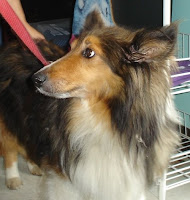
Chummy is with my crew. He follows the others around happily and wags his tail whenever anyone looks him in the eye - cat, dog or person. He is 9 and has a double hip replacement.
Both guys really need some work - coat wise and weight wise!
PS. It is a 7 hour round trip from my house to Presque Isle.
Thursday, July 3, 2008
Possum
New foster dog coming (in a week or two)! Her name is Possum. She is a 5 month old double merle sheltie who is deaf and partially blind.

She looks a lot like Bear!

Thursday, April 3, 2008
Nicholas Dodman Seminar - a review
This past Saturday, March 29, I attended a seminar at Happy Tails in Portland. The speaker was Dr. Nicholas Dodman, the director of the Tufts Cummings School of Veterinary Medicine's Behavior Clinic. The seminar covered aggression in dogs.
First, the facility. There was plenty of parking, plenty of seats, and the food served at lunch was good. The one drawback to the facility was that the heater was very loud, so it made hearing Dr. Dodman difficult at times.
Second, the seminar. The presentation was very professional - slides were on PowerPoint and a large screen was used so that everyone in the room could see. Dr. Dodman was hooked up to a microphone so that everyone could hear. He was a very easy speaker to listen to, repeated questions so that everyone could hear and stayed on topic extremely well (he was very polished).
Dr. Dodman covered owner-directed (dominance) aggression, fear aggression, separation anxiety and OCD behaviors in dogs. Each section was thoroughly covered and he even had example videos of each behavior. Parts of his lecture covered studies that he and others had performed.
A great seminar and worth every penny spent. Happily, happy Tails will be having Jean Donaldson and Ray Coppinger come speak also, plus other noteworthy trainers.
First, the facility. There was plenty of parking, plenty of seats, and the food served at lunch was good. The one drawback to the facility was that the heater was very loud, so it made hearing Dr. Dodman difficult at times.
Second, the seminar. The presentation was very professional - slides were on PowerPoint and a large screen was used so that everyone in the room could see. Dr. Dodman was hooked up to a microphone so that everyone could hear. He was a very easy speaker to listen to, repeated questions so that everyone could hear and stayed on topic extremely well (he was very polished).
Dr. Dodman covered owner-directed (dominance) aggression, fear aggression, separation anxiety and OCD behaviors in dogs. Each section was thoroughly covered and he even had example videos of each behavior. Parts of his lecture covered studies that he and others had performed.
A great seminar and worth every penny spent. Happily, happy Tails will be having Jean Donaldson and Ray Coppinger come speak also, plus other noteworthy trainers.
Friday, March 28, 2008
Lucky's Been Adopted
Lucky was turned over the sheltie rescue in late November 2007. At the time, he looked like this:


He was severely underweight and dehydrated. He had been run over by a car at some previous undetermined time, never taken in for vet care and his hips healed poorly. We didn't know if he could walk at all. But, even though you can't see it in the picture, his eyes were shiny and he hadn't given up.
He spent a week at Holly's vet and a day at a vet specialist's office before he came into foster care at my home. The poor little guy was also Lyme positive, very weak and had liquid poo (a technical term, that).
At first, the only food he would eat was chicken and rice. After a few weeks of this, I started mixing in dry Wellness puppy food. Eventually, he was able to eat, quite happily, Wellness Adult dog food.
Then, he started straining when he tried to poo. And, he didn't seem interested in his food. So, he went to my vet, where he stayed for a few days. He had a blockage. Of poo. See, when his hips had healed, one had healed pressed against where his intestine and colon came together. This caused the opening to be smaller than normal. He became constipated and was only able to pass a small bit of stool at a time. My vet had to perform surgery to remove the stool.
Sadly, there is no affordable surgery that a vet can do that would fix where his hip is. So, in order to prevent this problem from happening again, we humans have to make sure that his stool remains soft. While fiber and other natural methods might be OK, my vet recommended that we keep him on stool softeners. It is just far too easy for Lucky to become blocked again and surgery into the intestines carries its own risks.
After letting him heal from the surgery and figuring out the proper number of stool softeners he would need each day, I contacted Hilary and her family, since she had been very eager to adopt Lucky before he got ill.
What can I say about this family? I just wish I was a dog! They are some of the nicest people I have ever met and their grandson is a very nice young man. We arranged to meet them halfway between their house and mine (they live in another State) and the adoption day went very well. Lucky was kissing their grandson in no time and it was very obvious that this was the perfect home for him.
Lucky is right.
Tuesday, March 4, 2008
Toenails
Grace let me clip three (!) of her nails last night! Of course, she was a bit hesitant and pulled back a little on the third nail, but she did great. And, got lots of treats. We'll do a few more tonight.
She is also getting much better about going out the door. She will now come out of her crate when coaxed and, even though she "slinks" across the room, she will allow me to grab her collar when I need to and is walking much better on a leash. She doesn't bolt away in fear anymore, either. In fact, she is doing so well that I am no longer using a drag line inside the house.
Her crate is her safe spot, though, and she doesn't like to come out of it. But, she has gotten to the point where she will stand in the doorway to her little "cave" and watch me while I prepare a meal or give the other dogs their treats. Of course, she gets treats, too, but she isn't ready to brave the room to get one. So, I walk her treat over to her and she will take it out of my hand, rather than cowering in the back of the crate.
And, because she spends so much time in there, even with the door open, I make sure that she gets plenty of stuffed Kongs and playtime outside. The Kongs keep her mind busy and the playtime outside lets her really stretch her legs. She especially likes to roll in the powdery snow. And, she has begun interacting with Robbie and Ella. She greeted Maggie really well last night, too.
And, since the kitchen is the place where we practice our obedience training, she gets to watch the other dogs go through their cues. Last night, she watched Maggie practicing "down." Every once in awhile, I would toss a treat to Grace, just for paying attention while Maggie was in class.
This doesn't seem like much improvement, but it is. She is getting braver and more confident. Tiny baby steps on the road towards adoption.
She is also getting much better about going out the door. She will now come out of her crate when coaxed and, even though she "slinks" across the room, she will allow me to grab her collar when I need to and is walking much better on a leash. She doesn't bolt away in fear anymore, either. In fact, she is doing so well that I am no longer using a drag line inside the house.
Her crate is her safe spot, though, and she doesn't like to come out of it. But, she has gotten to the point where she will stand in the doorway to her little "cave" and watch me while I prepare a meal or give the other dogs their treats. Of course, she gets treats, too, but she isn't ready to brave the room to get one. So, I walk her treat over to her and she will take it out of my hand, rather than cowering in the back of the crate.
And, because she spends so much time in there, even with the door open, I make sure that she gets plenty of stuffed Kongs and playtime outside. The Kongs keep her mind busy and the playtime outside lets her really stretch her legs. She especially likes to roll in the powdery snow. And, she has begun interacting with Robbie and Ella. She greeted Maggie really well last night, too.
And, since the kitchen is the place where we practice our obedience training, she gets to watch the other dogs go through their cues. Last night, she watched Maggie practicing "down." Every once in awhile, I would toss a treat to Grace, just for paying attention while Maggie was in class.
This doesn't seem like much improvement, but it is. She is getting braver and more confident. Tiny baby steps on the road towards adoption.
Monday, March 3, 2008
Bark bark barkety bark
Grace was so excited about dinnertime last night that she started barking! She had her head stuck out of her crate and then pulled back into it, twirled and barked. It was a happy bark. An excited bark.
It also made Robbie start barking. I don't think the others had heard her bark before. I know that I haven't.
Shatzi was debarked on Thursday. After a few months of agonizing over this, asking other sheltie rescues what they would do and having quite a few potential adopters turn her down because of her barking, we decided to make the appointment and have her vocal cords nipped. Now, she sounds like a dog that has been smoking for 30 years - hoarse. And, much quieter.
When she barked for the first time with her new voice, it freaked Robbie out and he started barking at her. But, then again, lots of stuff makes Robbie bark.
She still barks, make no mistake. But, when she goes outside, I can't hear her inside and when I am outside with her, I know that the neighbors can't hear her, either. Their dogs might still be able to hear her, but that part doesn't concern me.
Inside, she seems to be barking less. Maybe it is because her barking no longer echoes around the room. She will bark once or twice and then stop, which is a new thing for her.
Now, we just have to work on the issue she has with cars - and, find her a forever home.
It also made Robbie start barking. I don't think the others had heard her bark before. I know that I haven't.
Shatzi was debarked on Thursday. After a few months of agonizing over this, asking other sheltie rescues what they would do and having quite a few potential adopters turn her down because of her barking, we decided to make the appointment and have her vocal cords nipped. Now, she sounds like a dog that has been smoking for 30 years - hoarse. And, much quieter.
When she barked for the first time with her new voice, it freaked Robbie out and he started barking at her. But, then again, lots of stuff makes Robbie bark.
She still barks, make no mistake. But, when she goes outside, I can't hear her inside and when I am outside with her, I know that the neighbors can't hear her, either. Their dogs might still be able to hear her, but that part doesn't concern me.
Inside, she seems to be barking less. Maybe it is because her barking no longer echoes around the room. She will bark once or twice and then stop, which is a new thing for her.
Now, we just have to work on the issue she has with cars - and, find her a forever home.
Tuesday, February 26, 2008
Look Away & Look At Me

The above picture shows a scared rescue dog "looking away." He is showing a lot of body language in this picture:
- He is looking away from the person holding him
- His ears are flat to his head
- His eye is showing white in a "whale eye" way
- His mouth is tight
Since it is not a video, we can not tell if he is also licking his lips or yawning. These are all signs that the dog is nervous and stressed. In this dog's case, he has every right to be - he is in a shelter, strangers are taking pictures of him (a camera is just a really big, shiny eye to dogs) and I am sure that the noise level there is fairly high.
But, there is hope:

Here, he is still scared, but looking at the camera. He is obviously used to making eye contact with humans and will be a quick learner for "Look" or eye contact. However, even if this dog never made eye contact, it would still be an excellent candidate for rescue. I haven't met a dog that hasn't been able to learn to meet my eyes.
Teaching eye contact is one of the easiest things I do with a foster dog. It doesn't require that I touch the dog. The dog doesn't need to know its name. All the dog has to be able to do is eat treats - and, be brave enough to eat those treats in my presence.
What you need are:
- Treats (pea sized)
- Treat bag (for keeping the treats in)
- Clicker
Begin by throwing a treat one at a time onto the floor. As soon as the dog picks up the treat, click. Do this about 10 times or so. We call this "charging the clicker" and it basically begins the association of clicker to treats.
Place a treat in one hand with your arm outstretched. As soon as the dog looks at the treat, click and give the treat. You can either hand the dog the treat or toss it to the dog. Repeat 20 or so more times. End session.
During the next session, which can be after a break or that evening or the next day, start with having the treat held like before. Click & treat about 10 more times. Now, bend your arm so that the treat is half the distance it was from your body. When the dog looks at it, click and treat. Repeat 20 or so more times. Now that the dog really knows what the clicker is for, make sure that you, every once in awhile, skip the treat, but not the click. This give a variable reinforcement to the click, which makes the behavior you are training more resistant to extinction (i.e., it doesn't get forgotten or go away easily).
If you have a really shy dog, you will want to stay at this step for a few sessions.
Now, for the next session, practice the previous sessions for a few clicks and then move your hand, with treat, so that the treat is held right between your eyes. When the dog looks at the treat, click & treat. Practice this a few sessions.
Now, move your hand so that your finger is pointing to between your eyes. When the dog looks there, click and treat. Repeat, repeat, repeat.
Now that you do not have to hold a treat to get the dog to look at you, you can now introduce a verbal cue (we call what we did before the physical cue - it is good to use both, since dogs can lose their hearing). I use "look" or the dog's name or both. Basically, point to your eyes and say look. When the dog looks, click and treat. Repeat, repeat, repeat.
I can usually get any foster dog, including the shy ones, to look at my face within a week. That is about 7 days of one session per day, with each session being no more than 5 minutes.
Some things to remember: if the dog starts showing those calming signals like the pictures above, back up a step in your training and do that step until the dog becomes comfortable. Then, move on to the next step. Keep an eye on the dog's body language the entire time you are training and make sure that he is always OK with what you are doing. If he isn't, step back and reevaluate.
Body Language
The body language of homo sapiens differs considerably from that of canis lupus familiaris. Ever seen a pair of dogs hugging? For most of us, a hug is a non-threatening part of communicating with another human. For a dog, a hug can be scary and nerve wracking, since in dog speak, when a dog places its paw on another dog's back, this can be taken as a challenge. Sometimes, it is part of play, too, but the dog can't always know this.
So, we monkeys need to be aware of how our body language impacts our canine companions. If we raise a dog from a puppy, that dog often naturally learns to read our body language. They aren't born knowing how to understand us, just as we need to learn to understand them. And, if we adopt a rescue dog, then we do not know what that dog has been taught about body language or how it was taught (positive reinforcement or punishment). We need to be prepared to help the dog learn to understand our body language and to change our own body language so that the dog is not threatened.
And excellent place to start is with the following books and websites:
"On Talking Terms with Dogs" by Turid Rugaas and her companion website http://www.canis.no/rugaas/ I really recommend the "Gallery" and Questions and Answers" section.
"Canine Body Language: A Photgraphic Guide" by Brenda Aloff is worth every penny. Through the extensive use of photographs, different body language is shown - between dogs and between dogs and humans.
These books are also invaluable in understanding when the dog is stressed and needs to be removed from a situation. When it might need a time out. When it is too stressed to learn.
Both books can be found on http://www.dogwise.com/
One of the things we teach rescue dogs is the ability to begin reading humans. I use calming signals, such as looking away, licking lips, turning sideways, crouching down, leaning back, and yawning to help calm a frightened dog so that it can begin to understand and trust humans.
So, we monkeys need to be aware of how our body language impacts our canine companions. If we raise a dog from a puppy, that dog often naturally learns to read our body language. They aren't born knowing how to understand us, just as we need to learn to understand them. And, if we adopt a rescue dog, then we do not know what that dog has been taught about body language or how it was taught (positive reinforcement or punishment). We need to be prepared to help the dog learn to understand our body language and to change our own body language so that the dog is not threatened.
And excellent place to start is with the following books and websites:
"On Talking Terms with Dogs" by Turid Rugaas and her companion website http://www.canis.no/rugaas/ I really recommend the "Gallery" and Questions and Answers" section.
"Canine Body Language: A Photgraphic Guide" by Brenda Aloff is worth every penny. Through the extensive use of photographs, different body language is shown - between dogs and between dogs and humans.
These books are also invaluable in understanding when the dog is stressed and needs to be removed from a situation. When it might need a time out. When it is too stressed to learn.
Both books can be found on http://www.dogwise.com/
One of the things we teach rescue dogs is the ability to begin reading humans. I use calming signals, such as looking away, licking lips, turning sideways, crouching down, leaning back, and yawning to help calm a frightened dog so that it can begin to understand and trust humans.
Friday, February 22, 2008
House training & Crate training
The more common term is "house breaking," but, I am not breaking the dog of using the house as a bathroom - I am actually training it that the house isn't the place to go - outdoors is. All dogs have accidents inside, especially when the are first brought into rescue. They are scared, confused, and don't understand the new rules. I expect a few mistakes and have plenty of paper towels on hand. Since house training and crate training pretty much go hand-in-hand, I teach them together.
When the foster dog first comes home, I allow it to greet the other dogs and then I lead it to its "assigned" crate. This crate is where foster dog will spend its time when I am not home and where it will get all of its meals and chew toys. I put foster dog into his crate and leave the leash on (so that I can get him out of the crate, too).
Then, I find an appropriate martingale collar and fix a drag line to it. And, I prepare every one's meal. Everyone is fed, including foster dog, in their own crate. After everyone has eaten, the other dogs go outside to go to the bathroom and play. Foster dog and I spend a little time adjusting the martingale collar and then the two of us go outside to go to the bathroom (outside of and away from the fenced in area where the other dogs are). As this point, I usually attach a 30 foot long leash onto foster dog to give him more room to sniff and do his business.
We stay outside until foster dog goes to the bathroom (or until I am freezing if it is winter). Some newly arrived dogs will not eat or go to the bathroom for a few days, so I don;t spend hours outside. If foster dog has gone to the bathroom, he gets praise, a whole bunch of treats and the ability to explore the house a little. If foster dog has not gone to the bathroom, he goes back into his crate with a chew toy.
I usually do my own thing now - eat my meal, answer e-mails, watch TV, play with my own dogs. When it is time for bed, the other dogs again go outside and foster dog and I go out and repeat the bathroom process. The foster dog is then crated for the night.
Note: I never leave a new foster and my own dogs unattended and uncrated until I have seen how they interact. There is always a chance that someone will not get along and a fight could occur. It is much easier to prevent this from happening - and takes less time - than having to go to the vet to treat a bite or an abscess!
Wwe repeat the bathroom process in the morning and throughout the day. Once I know that the foster dog gets along with my own dogs, he can go outside with them (off leash) and go to the bathroom that way. I just observe him through the window at this point and praise and treat when he comes in.
The cardinal rule for house training is that the dog is only allowed out of the crate (or off a leash attached to your waist) inside after he has gone to the bathroom outside. Frequent trips outside, treats and crating make quick work of housetraining. As foster dog gets more reliable, then he gets more freedom in the home.
For more detailed information on house training, check out "Way to Go! How to House Train a Dog of Any Age" by Patricia McConnell.
When the foster dog first comes home, I allow it to greet the other dogs and then I lead it to its "assigned" crate. This crate is where foster dog will spend its time when I am not home and where it will get all of its meals and chew toys. I put foster dog into his crate and leave the leash on (so that I can get him out of the crate, too).
Then, I find an appropriate martingale collar and fix a drag line to it. And, I prepare every one's meal. Everyone is fed, including foster dog, in their own crate. After everyone has eaten, the other dogs go outside to go to the bathroom and play. Foster dog and I spend a little time adjusting the martingale collar and then the two of us go outside to go to the bathroom (outside of and away from the fenced in area where the other dogs are). As this point, I usually attach a 30 foot long leash onto foster dog to give him more room to sniff and do his business.
We stay outside until foster dog goes to the bathroom (or until I am freezing if it is winter). Some newly arrived dogs will not eat or go to the bathroom for a few days, so I don;t spend hours outside. If foster dog has gone to the bathroom, he gets praise, a whole bunch of treats and the ability to explore the house a little. If foster dog has not gone to the bathroom, he goes back into his crate with a chew toy.
I usually do my own thing now - eat my meal, answer e-mails, watch TV, play with my own dogs. When it is time for bed, the other dogs again go outside and foster dog and I go out and repeat the bathroom process. The foster dog is then crated for the night.
Note: I never leave a new foster and my own dogs unattended and uncrated until I have seen how they interact. There is always a chance that someone will not get along and a fight could occur. It is much easier to prevent this from happening - and takes less time - than having to go to the vet to treat a bite or an abscess!
Wwe repeat the bathroom process in the morning and throughout the day. Once I know that the foster dog gets along with my own dogs, he can go outside with them (off leash) and go to the bathroom that way. I just observe him through the window at this point and praise and treat when he comes in.
The cardinal rule for house training is that the dog is only allowed out of the crate (or off a leash attached to your waist) inside after he has gone to the bathroom outside. Frequent trips outside, treats and crating make quick work of housetraining. As foster dog gets more reliable, then he gets more freedom in the home.
For more detailed information on house training, check out "Way to Go! How to House Train a Dog of Any Age" by Patricia McConnell.
Are You Ready for Adoption?
Each foster dog that I have needs to be evaluated before being placed for adoption. I evaluate the following:
Temperament
OK with other animals?
OK with children?
OK with strangers?
Fence needed?
Rides well in cars?
OK left alone?
Chews stuff?
Exercise level?
Knows any cues/tricks?
Another important part of fostering is making sure that the foster dog has the skills needed to successfully live in his/her new adoptive home. These are not necessarily obedience level skills, such as down or stay. An adoptive home can teach that. The skills that I am talking about are ones that make living with the dog easier – I call them “house manners.” Some of the skills that I, as a foster mum, make sure that my foster dogs have are:
Housetrained
Crate trained
Allows collar grabs
Knows name
Takes treats easily
Tolerates grooming
Knows cues for: Loose leash walking, sit, off the bed, quiet down (be quiet)
These skills are in addition to being spayed/neutered, up to date on shots, and healthy. At first, for a new foster home, evaluating and teaching all of these can be daunting, so I am going to write up what I do with each.
Thursday, February 21, 2008
Oh So Shy

Grace, a pretty blue and sable merle sheltie, came into rescue in early January. She isn't my first shy foster, but she has been the one who has needed the most care.
While at the puppy mill, Grace was in a kennel with far too many other shelties. There wasn’t enough food or water and there was no one who would clean the waste out of the kennel. As a result, all the shelties were stressed and they would fight amongst themselves. Grace was one of the weaker ones and she still has scars on her muzzle.
When the puppy mill was shut down, Grace was fostered by a volunteer for one of the shelters that helped with the closure. She stayed at this foster home for 3 months. Then, it was decided that Grace should be turned over to sheltie rescue, so she came to my home, since Holly’s was filled with puppies and our other foster homes were full, too.
Grace greeted the other dogs at my home very well, but showed some odd behaviors. She would roughly sniff the other dogs and sometimes growl and nip at them. Even though my dogs are well socialized, they really had no idea what was going on with Grace, so they started avoiding her. She got the cold shoulder from them, which, at the time, suited Grace just fine.
Towards me, she acted almost feral. She would overreact to noise and movements that I made – jump off the couch so hard that she would slam into furniture. She would run into the kitchen and slam into the patio door, not realizing that it was glass. She would jerk violently at the end of a leash and would jerk backwards when her collar was held.
It really seemed hopeless. I thought about finding a pet sanctuary for her where she could live out her days without human contact. I, who has shy dogs of my own, and who has fostered a number of shelties with behavioral problems, thought that there was nothing we could do for this dog. I cursed the people who did this to her. I cursed myself for agreeing to take her and for failing her.
But, I remembered how she sat in her previous foster mother’s lap. She had gotten up there on her own, under her own power. So, I realized that there was hope. There just had to be.
While at the puppy mill, Grace was in a kennel with far too many other shelties. There wasn’t enough food or water and there was no one who would clean the waste out of the kennel. As a result, all the shelties were stressed and they would fight amongst themselves. Grace was one of the weaker ones and she still has scars on her muzzle.
When the puppy mill was shut down, Grace was fostered by a volunteer for one of the shelters that helped with the closure. She stayed at this foster home for 3 months. Then, it was decided that Grace should be turned over to sheltie rescue, so she came to my home, since Holly’s was filled with puppies and our other foster homes were full, too.
Grace greeted the other dogs at my home very well, but showed some odd behaviors. She would roughly sniff the other dogs and sometimes growl and nip at them. Even though my dogs are well socialized, they really had no idea what was going on with Grace, so they started avoiding her. She got the cold shoulder from them, which, at the time, suited Grace just fine.
Towards me, she acted almost feral. She would overreact to noise and movements that I made – jump off the couch so hard that she would slam into furniture. She would run into the kitchen and slam into the patio door, not realizing that it was glass. She would jerk violently at the end of a leash and would jerk backwards when her collar was held.
It really seemed hopeless. I thought about finding a pet sanctuary for her where she could live out her days without human contact. I, who has shy dogs of my own, and who has fostered a number of shelties with behavioral problems, thought that there was nothing we could do for this dog. I cursed the people who did this to her. I cursed myself for agreeing to take her and for failing her.
But, I remembered how she sat in her previous foster mother’s lap. She had gotten up there on her own, under her own power. So, I realized that there was hope. There just had to be.

So, I re-read all of my behavioral books: the books in my library about fearful dogs, about dog body language, and the ones by people who owned and rehabilitated difficult dogs. I decided that someone had to help Grace and that would have to be me. Once I made that decision, I knew that things would get better.

The first thing I did was to fit Grace with a different collar. She had chewed off 2 nylon choke collars, 2 drag lines and a leash. In desperation, I put a chain choke on her. That worked, but it tightened unmercifully when she pulled and the tightness frightened her, which led to it getting tighter and her becoming more frightened. So, I found a Martingale collar that was made of nylon with a chain bit that hung in the front. It fits just right. She can’t get her mouth into the chain and the collar only tightens to a certain point – tight enough to not let her slip the collar, but not tight enough to choke her.
What an improvement.
Because she chews off her drag lines, I converted the chain choke into a drag line, with a long leash attached, so that I can catch her without cornering her or grabbing her. Now, I can pick up the leash and lead her to her crate or to the door and she doesn’t flip out (like a cat on a rope, as I like to say). She still needs improvement for walking on the leash, but we will get to that later.
I have also assigned to her a crate, instead of a corner of the couch. She was peeing on the couch instead of asking to go out (and then, when I would try to put her out, she would pee out of fear). Now, she hangs out in the crate when I am not there. She hasn’t made a mess of the crate, so she will be able to have her own bed and toys in there now. She is fed in there and gets a lot of treats in there. In just a few days, it has become her safe spot.
She is getting along much better with the other dogs. They still pretty much ignore her, but she has begun looking to them for guidance. If they go outside, she wants to go outside. If they come inside, she follows. She now gets excited about dinner time and has begun enjoying the chew treats. She was really impressed with the Booda Bone I got for her and spent an entire afternoon happily chewing – on the couch without any messes.
She still has a long way to go, though. At the most basic, she needs to be given a really good brushing, have her nails clipped, be given a bath and take a trip to the vet. She doesn’t trust me enough for me to do those things to her yet, though. I would muzzle her (for my safety) and do them, but she’ll live without them being done for the time being.
Right now, I am just happy when she will take a treat directly out of my hand, rather than me having to set it on the couch. It isn’t every time, but it is an improvement.
I keep telling myself that this dog deserves the best chance I can give her. My efforts now will enable her to be placed in a forever home that will love and cherish her. And, I want the next home she goes to to be her forever home. She will stay with me until we find that home.
Tuesday, December 18, 2007
Lucky update
Tuna fish and Lucky do not mix. He has truly been getting sick of the rice/hamburg/chicken concoction that I have been feeding him, so I left a tiny bit of tuna fish in a bowl for him and gave it to him with his meal.
Too much fat fed to a skinny sheltie = stinky messes on the floor and on them.
So, he spent the night downstairs last night.
Except, this morning, I woke up and he was beside the bed.
So, he must have climbed the stairs.
By himself.
Not bad for a sheltie that we though we might lose only 2 weeks ago.
Too much fat fed to a skinny sheltie = stinky messes on the floor and on them.
So, he spent the night downstairs last night.
Except, this morning, I woke up and he was beside the bed.
So, he must have climbed the stairs.
By himself.
Not bad for a sheltie that we though we might lose only 2 weeks ago.
Shatzi is on PetFinder!
Yep, the big girl is ready for her forever home!
Click here
Spread the word far and wide (I'll write up what we have been working on for the barking issues later).
Shatzi went to her forever home on May 24, 2008.
Click here
Spread the word far and wide (I'll write up what we have been working on for the barking issues later).
Shatzi went to her forever home on May 24, 2008.
Thursday, September 27, 2007
Dog Book Review: Cautious Canine
Cautious Canine: How to Help Dogs Conquer Their Fears
Patricia McConnell
$6.95
www.dogwise.com
This short book is a great primer for owners of shy and fearful dogs. Basically, Dr. McConnell teaches the reader how to use desensitization and counterconditioning (D&C) to help fearful dogs get used to unfamiliar people and situations. This positive method approach is extremely effective – I have used it on numerous foster dogs with great success.
The key to D&C is to use very high value treats and to start at a distance from the feared object where the dog is not showing any fear. For some, this distance might be only a few feet. For others, the distance is a few hundred feet and then small steps are taken over a long period of time to bring the dog closer to the feared object.
Recommended for the library of anyone who fosters dogs.
Patricia McConnell
$6.95
www.dogwise.com
This short book is a great primer for owners of shy and fearful dogs. Basically, Dr. McConnell teaches the reader how to use desensitization and counterconditioning (D&C) to help fearful dogs get used to unfamiliar people and situations. This positive method approach is extremely effective – I have used it on numerous foster dogs with great success.
The key to D&C is to use very high value treats and to start at a distance from the feared object where the dog is not showing any fear. For some, this distance might be only a few feet. For others, the distance is a few hundred feet and then small steps are taken over a long period of time to bring the dog closer to the feared object.
Recommended for the library of anyone who fosters dogs.
Wednesday, September 26, 2007
Foster Dog #8: Shatzi

Shatzi means "sweetheart" in German. She is definitely has a sweet sheltie heart. A really big sheltie heart!
Shatzi is the biggest sheltie I have ever met. She isn't huge like a Great Dane, but she is big for a sheltie. And, she has a bark to match. Big and loud. Especially when she sees or even hears a car.
So, Shatzi needs some training and needs some vetting and then can go to her forever home.

Tuesday, September 25, 2007
Charlie


Charlie Bear, an Aussie/Golden Retriever mix, stayed with us for one week. He was turned over to the Bangor Humane Society because he was too shy and did not warm up to the men in the family fast enough.
In the week that he stayed with us, he was a very good boy. However, he needed to be in a foster home with bigger dogs - the ones here are just too small for him to play with.
So, he traveled to another home and there he will stay until he is adopted!

Sunshiney Spirit


Spirit,
a Pom mix, looking very cute.
Smelly, but cute. She likes to roll in smelly things. Like skunk. And, deer poop.
She loves to bark. Sounds like she has been a smoker - hoarse and deep! You should hear her howl! At night, she loves to cuddle with me and Robbie.
Outside, she runs and runs. She is very fast and such a tease!


Friday, August 31, 2007
Growling
 In one of my previous posts, I mentioned a great book called "Culture Clash" by Jean Donaldson. I really think that every dog owner should have this book and should read it carefully.
One of the hardest parts about owning a dog is understanding them. And, to us, a growl is a scary thing. To a dog, it is supposed to be scary.
A growling dog is telling us that s/he is feeling like their personal space is being invaded. It means "Leave me alone." It means "You scare me and I want you to go away." It means "I am warning you. Please don't make me take evasive action."
So, we have to figure out why our dogs are growling, determine if we can help them with the problem and then help them. We should never punish a dog for growling.
If a dog is growling because it is afraid, which many rescue dogs are, then we need to analyse the environment and figure out what is
 causing their fear. At that point, we need to either remove the thing causing the fear or move the dog to a place where it isn't afraid. This protects the dog and the people around it. We do not want to inadvertently push the dog over its limits.
Then, we need to try to help the dog get over whatever it fears. I have talked a bit about this here.
Jelly Rolls, Hotdog Rolls, and Alpha Rolls
My dogs and I have a strong relationship filled with mutual respect. They have earned my respect by showing how forgiving and resilient they are when a new foster come home, when they are introduced to new situations and how incredibly intelligent beings they are. I feel that I have earned their respect by being a kind, loving, and confident leader. I am not dominating them. I am leading them. To me, there is a huge difference. One makes me look like a dictator. The other just puts me at the head of the household as the one who has responsibly to and for everyone else.
We practice the "Nothing in Life is Free (NILIF)" program in my home. I enjoy giving special food, treats and toys to my dogs. However, since the pack only gets these things once they have earned them, they aren't spoiled.
For instance, when I decide that everyone would get a biscuit, we practice NILIF. This is how it goes:
We practice the "Nothing in Life is Free (NILIF)" program in my home. I enjoy giving special food, treats and toys to my dogs. However, since the pack only gets these things once they have earned them, they aren't spoiled.
For instance, when I decide that everyone would get a biscuit, we practice NILIF. This is how it goes:
- I walk to the kitchen and open the biscuit jar. All the dogs rush into the kitchen behind me.
- I wait patiently, staring off into space, for said pack to figure out what I want from them.
- Ella is usually the first. She sits (look, she has done her work!).
- I say "good sit, Ella" and hand her a biscuit.
- Little doggie lightbulbs flicker on above the other dogs heads.
- One by one, each dog sits: Good sit, Maggie. Good sit, Blackie. Good sit, Duchess. Good sit, Robbie. Good sit, Bear. Good sit, Spirit.
With a new foster, sometimes the task at first is merely to take a treat from my hand once all the other dogs have gotten theirs. Then we work up to sitting with the others. No fighting and no stealing treats. No jumping, either. No treat for misbehaving - once the dog settles, THEN they get the treat.
Please notice that I do not ask them to sit. I am merely waiting for them to figure it out.
NILIF goes both ways. If I want well behaved dogs, then I have to work for it. If they want a treat, then they have to work for it.
So, how do I deal with bad behavior?
First, I try to prevent it. If that doesn't work, I will give time outs in crates and separate rooms.
For instance, I like to give bully sticks to the dogs at least once a week to keep their teeth clean and their breath fresh. Seven dogs = seven sticks, right? Wrong! I always have a couple of extra sticks in various spots, in case someone gets up and has their stick taken - there is usually one lying nearby that they can chew on.
Should two dogs decide to go for the same stick and start an argument, I immediately ask them to Stop! in a calm, loud voice (to penetrate the snarling) and take all sticks away from all dogs. Everyone then gets a time out for a half-hour or so or we go do something else, like go to another room.
Another way to use NILIF is at the dinner table. My dogs, at my home, have learned that if they wait quietly, they will get a treat when I am finished with my meal. I did this by completely ignoring them while I was eating and every once in awhile giving them a treat for laying or sitting quietly. Seems a little counter intuitive, doesn't it? It does work, though. It does take some time, too, and all family members have to do the same thing or it won't work (if you have a child slipping the dog food through the whole meal, this method probably won't work).
All of these things that I do help to make my household harmonious. Not quiet, mind you, but harmonious.
Do I ever alpha roll them, like some trainers suggest? No. I don't need to. And, dogs don't alpha roll each other, either. The submissive animal rolls itself. My dogs and I co-exist as a team, remember, so I certainly do not expect them to be submissive to me nor do I expect them to submit to me - what they do, they do of their own accord, because it makes sense to them - because we are a team. Because of respect. Because I ask, not command.
Remember, they respect me and I respect them. I am a benevolent leader and I think about problems and watch for them before they become problems. That's my job, as the one with the bigger brain. I have a routine that I stick to, morning and night. I provide enough things for my dogs to do to keep their minds and bodies active. I know that they are dogs, not furry humans. I make sure that I teach them what I want them to do, rather than punish them for doing something I don't want them to do.
Subscribe to:
Posts (Atom)